
Hyundai Kona: Evaporative Emission Control System / Repair procedures
Hyundai Kona (OS) 2018-2026 Service Manual / Emission Control System / Evaporative Emission Control System / Repair procedures
| Inspection |
[System Inspection]
| 1. |
Disconnect the vapor hose from the intake manifold and connect a vacuum
pump to the nipple on the intake manifold.
|
| 2. |
Check the following points with applied vacuum at the purge control
solenoid valve (PCSV).
|
[PCSV Inspection]
| 1. |
Turn ignition switch OFF and disconnect the negative (-) battery cable.
|
| 2. |
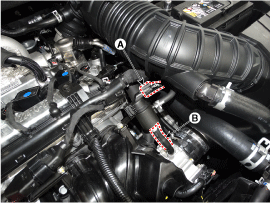
Disconnect the PCSV connector (A).
|
| 3. |
Disconnect the vapor hose (B) which is connected to the intake manifold
from the PCSV.
|
| 4. |
After connecting a vacuum pump to the nipple, apply vacuum.
|
| 5. |
With the PCSV control line grounded, check the valve operation with
battery voltage applied to the PCSV (Open) and removed (Closed).
|
| 6. |
Measure the coil resistance of the PCSV.
|
[EVAP. Leakage Test]
| 1. |
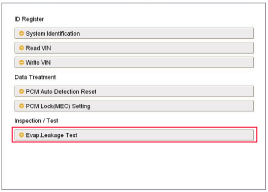
Select "Evap. Leakage Test".
|
| 2. |
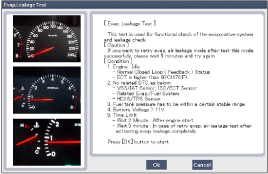
Proceed with the test according to the screen introductions.
|
 Schematic diagrams
Schematic Diagram
Canister
The Canister is filled with charcoal and absorbs evaporated fuel vapor from
the fuel tank. The gathered fuel vapor in canister is drawn into the i ...
 Canister Repair procedures
Removal
1.
Turn ignition switch OFF and disconnect the negative (-) battery cable.
2.
Lift the vehicle.
3.
Dis ...
Other information:
Hyundai Kona (OS) 2018-2026 Service Manual: Cylinder Block Repair procedures
Disassembly
•
Use fender covers to avoid damaging painted surfaces.
•
To avoid damaging the cylinder head, wait until the engine coolan ...
Hyundai Kona (OS) 2018-2026 Owners Manual: Service reminder
If the remaining mileage or days is below 1,500 km or 30 days, the service reminder
will be displayed with a warning sound for a few seconds each time you turn the
ignition switch to the ON position.
Information
To change or deactivate the service interval, consult an authorized HYUNDAI
dealer.
...
© 2018-2026 www.hkona.com
