
Hyundai Kona: Air Conditioning System / Evaporator Temperature Sensor Repair procedures
| Inspection |
| 1. |
Turn the ignition switch OFF.
|
| 2. |
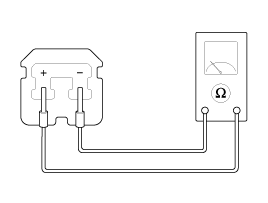
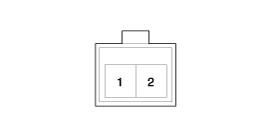
Disconnect the evaporator temperature sensor connector.
|
| 3. |
Measure the resistance between terminal "+" and "-" of the evaporator
temperature sensor.
Specification
|
| Diagnosis With GDS |
| 1. |
The heating, ventilation and air conditioning can be quickly diagnosed
failed parts with vehicle diagnostic system (GDS).
※ The diagnostic system (GDS) provides the following information.
(1) Self diagnosis : Checking the failure code (DTC) and display.
(2) Current data : Checking the system input/output data state.
(3) Actuation test : Checking the system operation condition.
(4) Additional function : Other controlling such as he system option
and zero point adjustment.
|
| 2. |
Select the 'Car model' and the system to be checked in order to
check the vehicle with the tester.
|
| 3. |
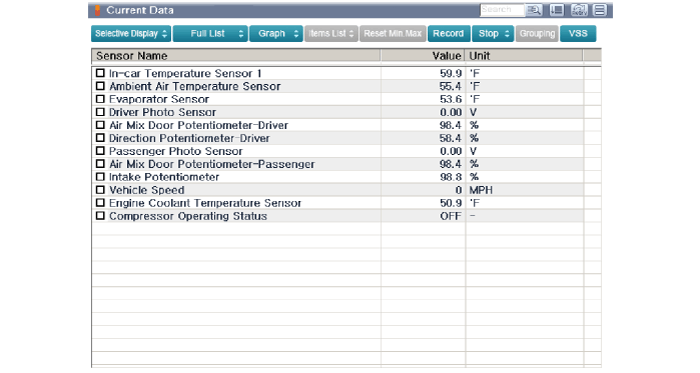
Select the 'Current data' menu to search the current state of the
input / output data.
The input / output data for the sensors corresponding to the Evaporator
Temperature Sensor can be checked.
|
| Replacement |
| 1. |
Disconnect the negative (-) battery terminal.
|
| 2. |
Remove the heater and blower unit from the crash pad after loosening
the mounting nuts.
(Refer to Heater - "Heater Unit")
|
| 3. |
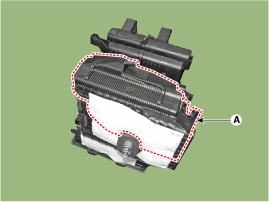
Remove the evaporator core cover (A) after loosening the mounting
screws.
|
| 4. |
Pull out the evaporator core (A) from the heater unit.
|
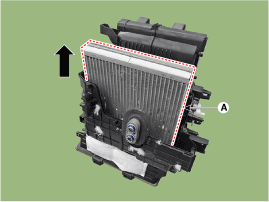
| 5. |
Remove the evaporator temperature sensor (A) from the evaporator
core.
|
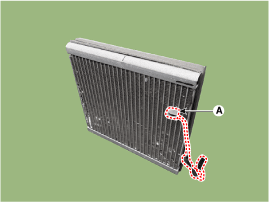
| 6. |
To install, reverse the removal procedure.
|
 Evaporator Temperature Sensor Description and operation
Description
The evaporator temperature sensor will detect the evaporator core temperature
and interrupt compressor relay power in order to prevent evaporator from
freezin ...
 In-car Sensor Description and operation
Description
The In-car air temperature sensor is built in the heater & A/C control unit.
The sensor contains a thermistor which measures the temperature of the inside. ...
Other information:
Hyundai Kona (OS) 2018-2026 Service Manual: Blower Resistor (Manual) Repair procedures
Inspection
1.
Measure the resistance between the terminals.
2.
The measured resistance is not within specification, the blower
resistor must be replaced. (After removing the resistor)
...
Hyundai Kona (OS) 2018-2026 Owners Manual: Check tire pressure
You can check the tire pressure in the Assist mode on the cluster. Refer
to the "LCD Display Modes" in chapter 3.
Tire pressure is displayed after a few minutes of driving after initial
engine start up.
If tire pressure is not displayed when the vehicle is stopped, "Drive
to display" mess ...
