
Hyundai Kona: Engine Control System / Knock Sensor (KS) Description and operation
Hyundai Kona (OS) 2018-2026 Service Manual / Engine Control / Fuel System / Engine Control System / Knock Sensor (KS) Description and operation
| Description |
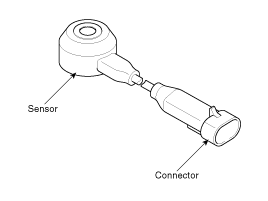
Knocking is a phenomenon characterized by undesirable vibration and noise and
can cause engine damage. Knock Sensor (KS) is installed on the cylinder block
and senses engine knocking.
When knocking occurs, the vibration from the cylinder block is applied as pressure
to the piezoelectric element. When a knock occurs, the sensor produces voltage
signal. The ECM retards the ignition timing when knocking occurs. If the knocking
disappears after retarding the ignition timing, the ECM will advance the ignition
timing. This sequential control can improve engine power, torque and fuel economy.
 Camshaft Position Sensor (CMPS) Repair procedures
Inspection
1.
Check the signal waveform of the CMPS and CKPS using the GDS.
Specification : Refer to "Wave Form"
...
 Knock Sensor (KS) Specifications
Specification
Item
Specification
Resistance (MΩ)
4.87
...
Other information:
Hyundai Kona (OS) 2018-2026 Service Manual: Windshield Wiper-Washer Switch Repair procedures
Removal
1.
Disconnect the negative (-) battery terminal.
2.
If it is necessary to remove multifunction switch assembly, remove
the steering wheel.
(Steering System - "Steering Wheel")
...
Hyundai Kona (OS) 2018-2026 Service Manual: Hood Assembly Repair procedures
Replacement
•
Be careful not to damage the hood and body.
•
...
© 2018-2026 www.hkona.com
