
Hyundai Kona: Tail Gate Window Glass / Repair procedures
| Removal |
|

|

| 1. |
Remove the tailgate trim.
(Refer to Tailgate - "Tailgate Trim")
|
| 2. |
Remove the rear spoiler.
(Refer to Body Side Molding - "Rear Spoiler")
|
| 3. |
Disconnect the hot wire connector (A).
|

| 4. |
Cut off the sealant on the edge (B) while pulling the piano wire (A)
to the left and right.
|


| 5. |
Put in a piano wire (A) through the corner of the tailgate window glass
and insert wire grips into both ends of the wire.
|

| 6. |
Cut off the sealant on (A-A), (B-B), (C-C), while pulling a piano wire
(A) to the left and right.
|

| 7. |
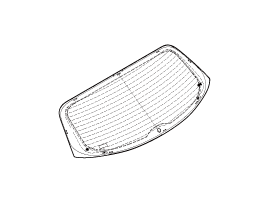
Remove the tailgate window glass (A).
|

| Installtion |
| 1. |
Using a cutting knife (A), remove the remaining sealant (B) on the body
panel.
|

| 2. |
Apply the body primer to the bonding surface of body panel.
|

| 3. |
Apply the glass primer to the outer edge of tailgate window glass.
|
| 4. |
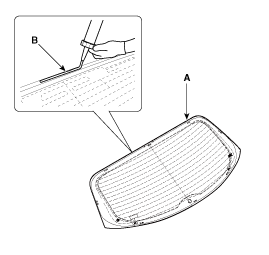
Using a sealant gun, apply the sealant (B) to the edge of rear tailgate
window glass (A).
|
| 5. |
Using the glass holder, adjust the tailgate window glass (A) to fit
the alignment marks (B) on the body and lightly push the tailgate window
glass to make the edges fully seated on the bonding surface of body.
|

| 6. |
To make sure that the applied sealant is completely hardened, leave
the car on a flat surface for at least 3 to 4 hours after installing
the tailgate window glass.
|
| 7. |
Conduct a leak testing.
|
| 8. |
Install the rear spoiler.
(Refer to Body Side Molding - "Rear Spoiler")
|
| 9. |
Install the tailgate trim.
(Refer to Tailgate - "Tailgate Trim")
|
 Components and components location
Components
1. Tailgate window glass
...

Other information:
Hyundai Kona (OS) 2018-2026 Service Manual: Condenser Repair procedures
Inspection
1.
Check the condenser fins for clogging and damage. If clogged, clean
them with water, and blow them with compressed air. If bent, gently
bend them using a screwdriver or pliers.
2.
Check the cond ...
Hyundai Kona (OS) 2018-2026 Owners Manual: Seat belt safety precautions
Always fasten your seat belt and make sure all passengers have fastened their
seat belts before starting any trip. Air bags are designed to supplement the seat
belt as an additional safety device, but they are not a substitute. Most countries
require all occupants of a vehicle to wear seat belts. ...
