
Hyundai Kona: Wireless Power Charger System / Wireless Power Charging Unit Repair procedures
Hyundai Kona (OS) 2018-2026 Service Manual / Body Electrical System / Wireless Power Charger System / Wireless Power Charging Unit Repair procedures
| Removal |
Handling wireless charging system parts by wet hands may cause electric
shock.
|

| 1. |
Disconnect the negative (-) battery terminal.
|
| 2. |
Remove the floor console cover assembly.
(Refer to Body - "Floor Console Assembly")
|
| 3. |
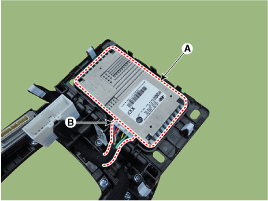
Remove the wireless power charger unit (A) after mounting screws
and disconnecting the connector (B).
|
| Installation |
| 1. |
Install the wireless power charging unit.
|
| 2. |
Connect the wireless power charging unit connectors.
|
| 3. |
Install the floor console assembly.
|
| 4. |
Connect the negative (-) battery terminal.
|
| [Diagnosis With KDS/GDS] |
| 1. |
The body electrical system can be more quickly diagnosed for troubles
by using the vehicle diagnostic system (KDS/GDS).
KDS/GDS provides the following information.
|
| 2. |
To diagnose the vehicle by using the diagnostic equipment, select
"vehicle model" and "wireless power charger system" to be inspected.
|
| 3. |
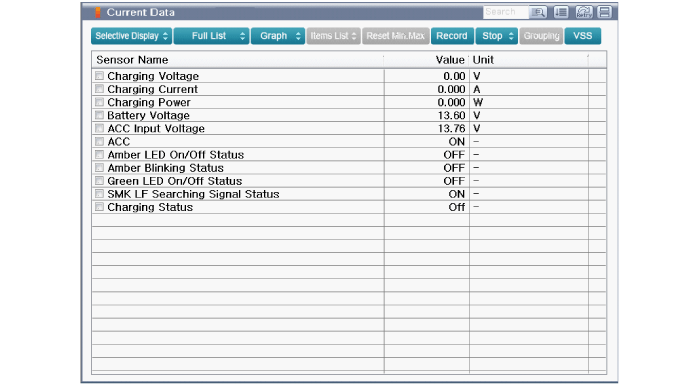
To inquire the current status of input/output values, select the
"Sensor Data" menu
The input/output values of the sensors corresponding to the selected
module can be checked.
|
| 4. |
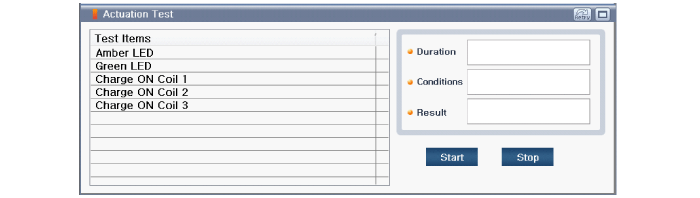
To perform forced operation of the selected module input, select
"Actuation Test".
|
| 5. |
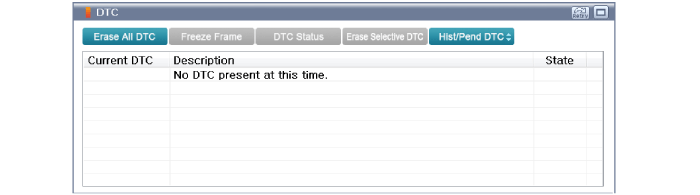
To inquire the cause of trouble for each module by self diagnosis,
select 'Diagnostic Trouble Code'.
|
 Wireless Power Charging Unit Circuit diagram
Circuit Diagram
...
 Wireless Charging Lamp Components and positions
Components
...
Other information:
Hyundai Kona (OS) 2018-2026 Service Manual: Receiver-Drier Repair procedures
Replacement
1.
Remove the condenser.
2.
Remove the cap (A) on the bottom of the condenser with a L wrench.
Tightening torque :
9.81 - 14.71 N.m (1.0 - 1.5 kgf.m, 7 ...
Hyundai Kona (OS) 2018-2026 Service Manual: DC/DC Converter Components and components location
Component Location
1. DC/DC Converter [450W]
2. DC/DC Converter
[200W]
...
В© 2018-2026 www.hkona.com
